
Montgomery County Deed Records and What They Show
A recorded deed is the instrument the Montgomery County Clerk accepted. The office stamped and indexed it under its named parties. Expect the grantor, the grantee, and execution and recording details. You should also see some indication of consideration and the full legal description of the parcel. The deed's label, whether warranty or quitclaim, matters. It tells you what transfer the parties claimed to make. It does not, standing alone, promise clean title.
| Deed Type | What It Does | Common Use |
|---|---|---|
| Warranty deed | Conveys the stated interest with covenants written in the instrument | Ordinary sale where those covenants are used |
| Quitclaim deed | Conveys whatever interest the grantor has without promising that interest exists | Family or corrective transfer |
| Executor or fiduciary deed | Conveys through an authorized estate or fiduciary role | Estate administration |
| Referee deed | Records a conveyance made through a court-authorized sale | Foreclosure-related transfer |
| Corrective deed | Repairs an error in an earlier instrument | Name or description correction |
Not every entry in the land index changes ownership. A mortgage only secures a debt. An assignment passes a lender's interest to another lender. A discharge or release retires that recorded security. A lis pendens warns of pending litigation touching the property. Yet it never proves a foreclosure finished. Read each of these instruments beside the deed itself. Do not treat the whole index as a string of ownership transfers.
The Montgomery County Grantor-Grantee Index
SearchIQS arranges Montgomery County deed records through party names and document fields. Start with the deed by which the current owner acquired the tract. That document's grantee is your owner of record. Its grantor is the next link back. Repeat the pairing generation by generation and the chain assembles itself. At each step, match the legal description and any parcel clues. One person often held several tracts under a single name.
- Find the present owner's acquiring deed with that owner searched as a grantee.
- Read the grantor, legal description, date, and recording reference from the image.
- Search that grantor as an earlier grantee, then compare the parcel description.
- When the chain passes the online cutoff, continue with Clerk deed books, indexes, and historical resources.
- Grantor
- The party transferring the stated interest.
- Grantee
- The party receiving the stated interest.
- Chain of title
- The ordered sequence of recorded ownership instruments for the land.
- Book/page or instrument number
- The Clerk reference used to retrieve a specific recorded document.
Getting a Copy of a Montgomery County Deed
SearchIQS sells electronic access to the index and images under posted subscription terms. The Clerk also sets out public computers for searching and printing on site. For a mail request, send the party names, the property address, an approximate recording date, and the document type. Include a self-addressed stamped envelope. The copy page lists a $5 search fee covering each two-year period. It adds $1 per page for that mail procedure. The separate fee schedule prices recorded-document copies at $0.65 per page with a $1.30 minimum. Clerk-prepared copies run $1 per page. Preparation plus certification costs $4 with $1 per page. Confirm the right procedure and total charge before mailing payment.
Recorded, not guaranteed. Montgomery County deed records show instruments accepted for recording. The index is not a title opinion, and an attorney or title professional should evaluate title and possible unrecorded interests.
SearchIQS Deed Coverage
The published coverage table gives deeds from December 15, 1971 forward. Both the index and images are included. Treat that date as an online boundary. It is not the start of land ownership in Montgomery County. Mortgages begin June 16, 1972, assignment mortgages later that June, and lis pendens in 1973. Maps carry images from 2010 on, while 1995 through 2009 remains index only. Each document group needs its own coverage statement. The Montgomery County SearchIQS coverage table is the source for these cutoffs.
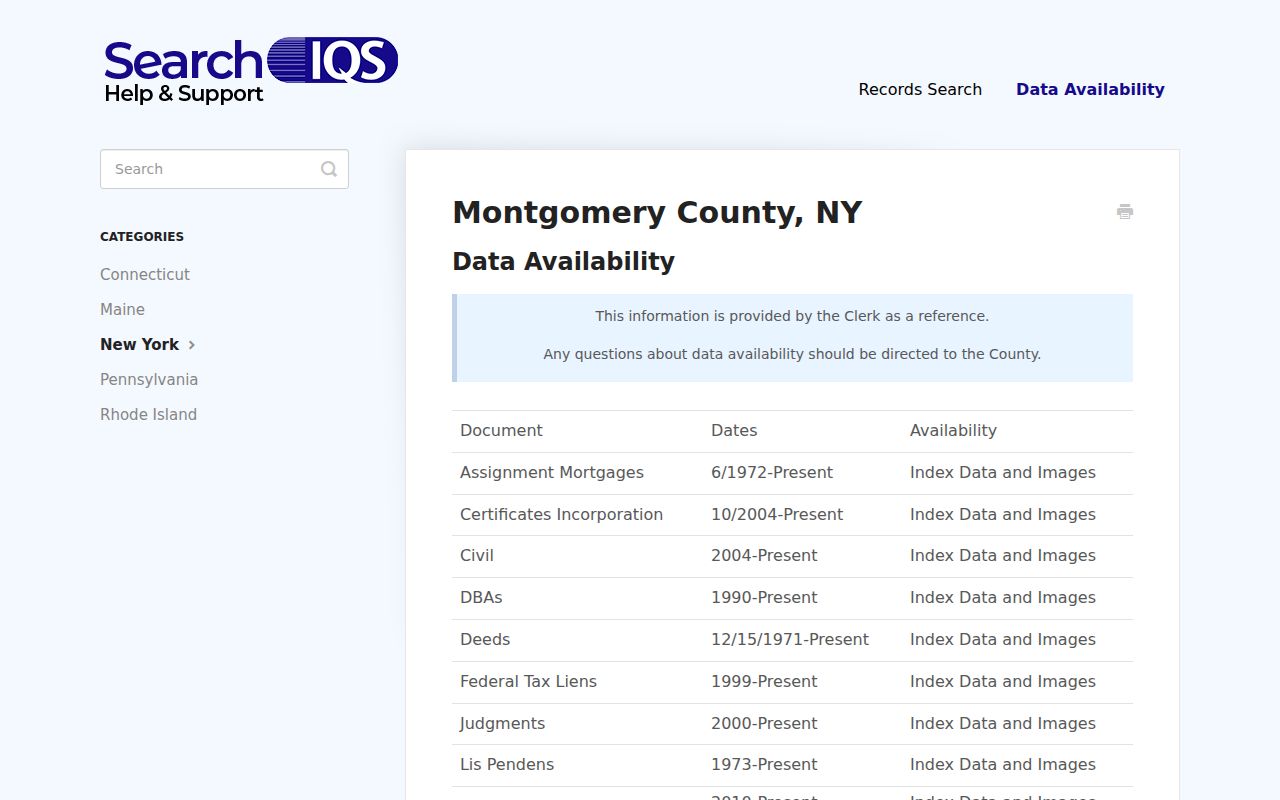
The official coverage table shows that deeds, mortgages, maps, liens, and the other document groups each begin at their own date. There is no single start line shared across the index.
Montgomery County Deed Search Fields
SearchIQS help materials list the controls: Party 1, Party 2, date, document group, town, book and page. One more control exists. The instrument number completes the list. Party 1 and Party 2 mean different things depending on the document group chosen. Date and document-group filters cut the noise, and the returned image settles any doubt. Exact names help. But expect to try variants for initials, punctuation, business suffixes, maiden names, and estate wording. The official SearchIQS search-screen help displays the available land-index fields.
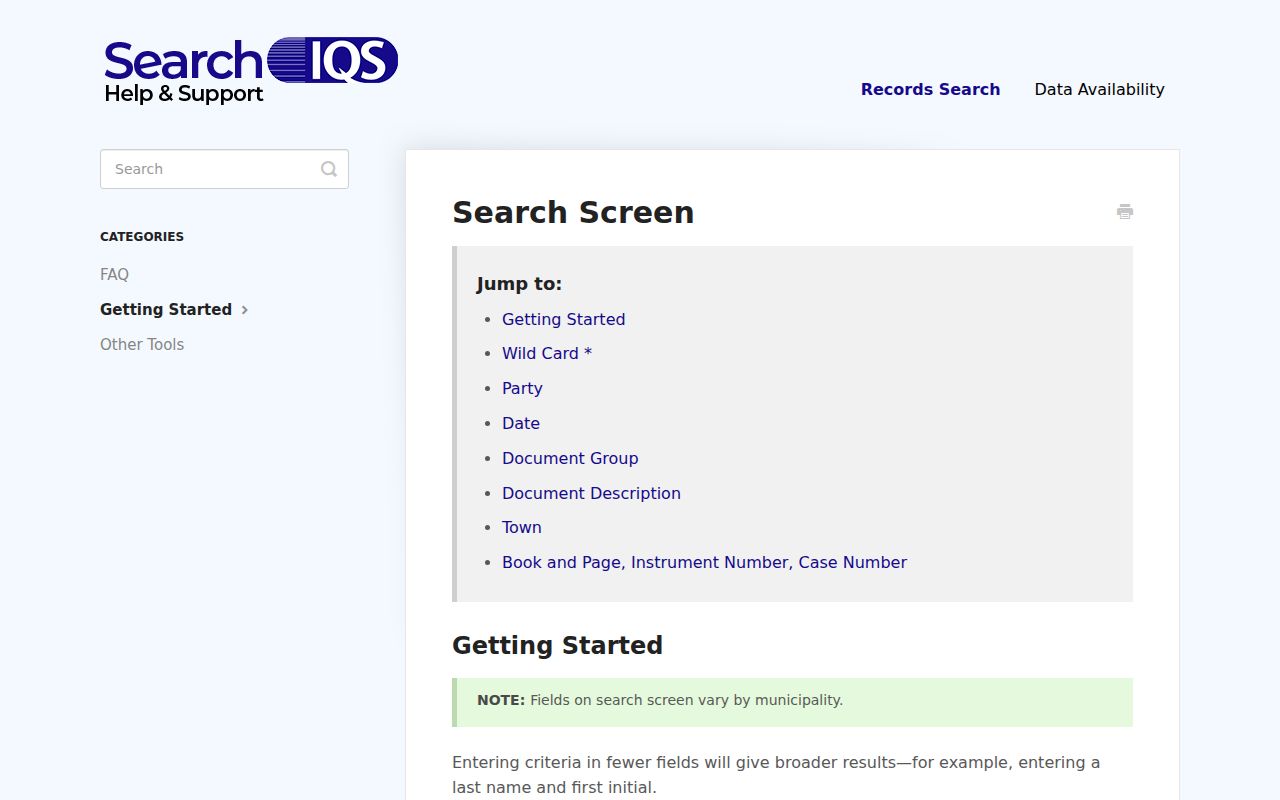
The captured help screen supports a field-by-field search instead of a broad name guess.
| Search control | Use | Caution |
|---|---|---|
| Party 1 and Party 2 | Locate indexed parties | Roles vary by document group |
| Date range | Narrow recording period | Recording and execution dates may differ |
| Document group | Separate deeds from mortgages, maps, or liens | Do not treat every hit as a conveyance |
| Town | Limit municipal context | Historic descriptions can differ |
| Book/page or instrument | Retrieve a known record | Copy the reference exactly |
Older Montgomery County Deeds
When a chain runs past the online deed range, take it to the County Clerk. The County Historian can also help. Physical indexes, deed books, microfilm, and cataloged historical material carry the work backward. The Historian holds Tryon and Montgomery land records from 1772 through 1788. Early assessment material is there too. Atlases from 1853, 1868, and 1905 round out the collection. Montgomery County was Tryon County in 1772. A very early instrument may carry a county name or place description that bears no resemblance to a modern address. Work from a known later deed back toward the older material. Tie every early source back to the deed's legal description.
The Historian's house-history method points the same way. Combine deed chains with assessments, permits, maps, directories, and Sanborn sheets instead of chasing an old address alone. Those parallel records often identify a tract or owner that the deeds alone leave vague.
WPA projects copied, filed, and rebound local records after the Historian department formed in 1934. When an original town, village, or church record is fragile, ask whether a WPA copy or transcript survives. No official account of a courthouse fire destroying a named span of Montgomery deed books exists. Gaps in the online index are not record loss.
Recording Package Documents
A real-estate recording in Montgomery County can involve far more than the deed itself. The Clerk's land-record materials include the TP-584 and RP-5217 forms, along with the full legal description of the parcel. Mortgages, assignments, and discharges often get recorded close to the transfer. So do powers of attorney and estate releases. Those documents matter when a signer's name differs from the owner of record, since they explain the gap. Whenever a deed cites another recorded authority, search that related record group too.
Fees come from the Clerk's posted schedule. A deed runs $5 per page plus $45 with the cover sheet, with added charges for extra names and document notations. TP-584 is $5. RP-5217 is $125, or $250 for vacant-land or commercial filings. Copy charges are billed separately. Because recording fees can change, check the current Clerk schedule before you prepare a filing.
For map filings, the Clerk allows paper or mylar under Real Property Law section 334(2-a), effective February 3, 2025. That shift reflects digitization, image quality, and material cost. It does not put every old map image online.
Fraud Alerts for Recorded Names
The County Clerk offers a link to the free SearchIQS Fraud Alert service. Enrollment takes an email address and up to ten person or company names. You then activate those names. A new record matching your terms hits the system for the chosen jurisdiction. The service then sends a notice. It lets an owner watch future Montgomery County property recordings without rerunning a deed search every day.
Know the limits. An alert is not real time. It does not block a recording, and it is no title guarantee. Common names can trigger notices that have nothing to do with you. Match any alert against the property, the parties, the document type, and the official Clerk record before acting. If a deed looks unauthorized, take it promptly to the Clerk, an attorney, and the proper authorities. Do not rely on the email alone.
New York Attorney General deed-theft guidance points the same way: check your property records and respond to suspicious changes. The defensive use is narrow. Monitor your own name and verify any record that surprises you.