
How to Find Who Owns a Montgomery County Property
The method moves from land to name, then from name to the recorded conveyance. Find the parcel first. Neither a broad people search nor a mailing address proves title. A tax bill does not prove title either. The SBL anchors every step to the right Montgomery County parcel.
- Search the address in Montgomery County PROS or the correct final assessment roll and record the SBL and CURRENT OWNERS NAME.
- Use the roll's deed book and page or owner name to retrieve the latest deed from SearchIQS or the County Clerk.
- If the owner is an LLC or corporation, match the exact name in the New York business entity database without treating the agent as the landowner.
- Use the published mailing address only for a lawful property-related contact and recognize that it can differ from the situs.
Where Montgomery County Owner Information Comes From
Several official sources can name an owner. Each answers a different question. The assessment roll reports the owner carried for that roll, while the Clerk index lists parties to recorded instruments. A state entity result explains a business name, the tax bill mostly reports fiscal data, and combining sources beats accepting the first name returned.
| Source | Owner Info It Gives | Access |
|---|---|---|
| Final roll or PROS | Current roll owner, mailing address, situs, SBL, deed reference | County web sources and assessor |
| County Clerk / SearchIQS | Grantee and grantor on the newest recorded deed | Online subscription, public computers, or copies |
| New York business entities | Entity name, status, jurisdiction, and service information | State database |
| Parcel History | Owner and transfer leads tied to the parcel | SBL, owner, or PH-number search |
Ownership and occupancy are different things. The owner may live elsewhere. Land can sit inside an entity, or the tax mail may go to a separate address, and a relative, property manager, or business on the site does not become the deed owner just by being there. Keep the question anchored in the assessment roll and the recorded deed.
What "Who Owns This Property" Cannot Tell You
The roll cannot confirm who lives there. It is not a title report either. New York programs, including the Address Confidentiality Program, protect some actual addresses, and confidential voter rules can restrict other address records. An omitted or substitute address never means the parcel has no owner.
Lawful use. Use a Montgomery County owner lookup for purchase diligence, deed checks, boundary questions, estate work, or civic research. Never use owner information to stalk, harass, threaten, or harm anyone.
Read the Montgomery County Owner Field
The Amsterdam roll labels its field CURRENT OWNERS NAME. Nearby columns separate mailing address from property location. That distinction matters. A different mailing city does not mean the owner is unrelated to the parcel, and a matching situs and mailing address does not prove anyone lives there. For the official owner field on a selected municipal roll, use the final assessment roll index, which offers municipality and year choices.
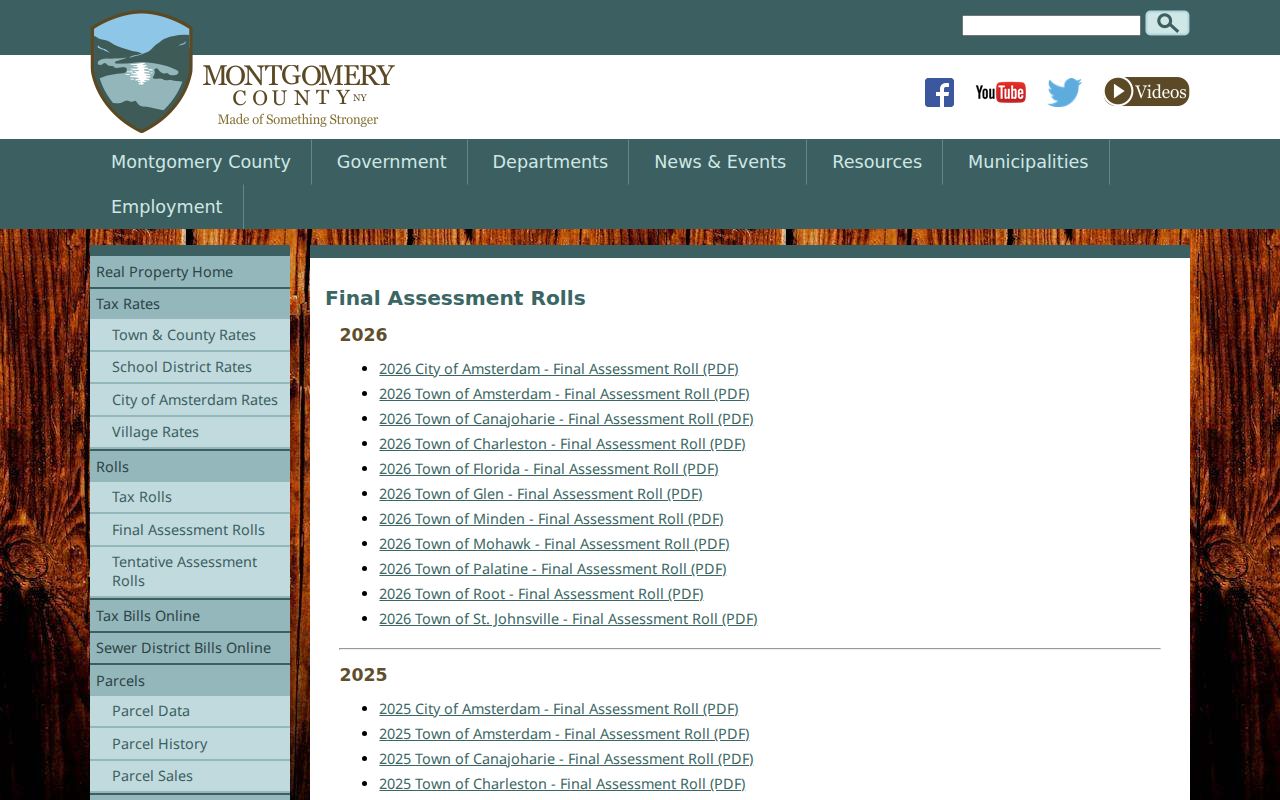
The county roll index opens each municipal owner field.
- Owner of record
- The name carried on the official roll or recorded instrument for that source date.
- Vesting
- The way title is stated as held by the grantee or grantees in the deed.
- Grantee
- The party receiving the interest described by a deed.
- Situs
- The physical property location, distinct from an owner's mailing address.
Confirm the Latest Montgomery County Deed
The roll's deed book and page can lead straight to the Clerk record. Sometimes the reference is missing or old. Then search the roll owner as a grantee in SearchIQS, narrow by deed group and date, and compare the legal description. Online deed coverage starts December 15, 1971. Earlier deeds live in Clerk books and indexes. For a full chain before that date, the Clerk's books, indexes, and historical sources take over. A deed index hit alone proves little. Open the image. Read the full party names, transfer wording, legal description, and recording data. Confirm the instrument concerns the same SBL or land description. Joint owners may be indexed under more than one party, and a fiduciary or power of attorney may sign without becoming the fee owner. A recent sale can outpace the roll. The newest deed may postdate the final roll. Montgomery County warns that transfer data may arrive after bills are mailed, and it publishes no fixed lag period, so resolve any mismatch by date and instrument rather than assuming an office erred.
LLC Owners in Montgomery County
An LLC or corporation on the roll is not the end of the trail. Copy the entity name exactly. Then run it through the New York Department of State Corporation and Business Entity Database. Results can show the current entity name, organization date, jurisdiction, county, service-of-process address, registered agent, and status. Business corporations may add chief executive details. The state database updates daily. Its older inactive filing history has limits, though. It explains the legal entity behind the roll string but names no beneficial owner and proves no title. A registered agent or service address is not automatically the parcel owner. Return to the deed for the named grantee. The New York business entity search is the official state route, and county-filed assumed names sit in the Montgomery County Clerk DBA records. A DBA never conveys the real estate.
Estate and Trust Ownership
Fiduciary labels demand close reading. The roll may carry an estate name while probate administration continues. An authorized representative may execute the deed. Search the deed itself. Also search public Surrogate or eCourts material to understand the authority behind a signature. A probate docket alone never transfers the parcel. Trusts complicate the index. Ownership may sit under a trustee's name or the trust wording in the deed. Search both variants and examine the instrument. No public roll reveals every beneficiary. So end with what the official records support instead of speculating about private interests. For an heir or historic chain, begin with the current deed and work backward. Vital and genealogy records carry eligibility and waiting-period rules. So treat them as supporting context only. The former-owner method covers the backward deed chain in detail.
Montgomery County Transfer Lag
Recording schedules rarely line up in Montgomery County. A deed, the assessment roll, parcel history, and the tax bill may each update on different days. That gap matters for property records. County guidance says a former owner or escrow service may still receive the post-transfer bill. Real Property sets no fixed day count for changing the owner field.
Write down the deed's recording date. Then compare it with the final-roll year and the bill year before judging who holds title. Timing counts most when the question is who owns the property now. The newest recorded deed settles it. Ask Real Property about the next roll. Leave the historical roll name alone. It accurately reports what that roll carried at its effective date.
A split or merger adds another delay. The deed and current SBL may not appear together. Ask Real Property for the parent or child parcel link and check the legal descriptions.
When the Owner Is Not Online
When PROS returns nothing for the address, turn to the correct municipal final roll. The tax roll often settles the question of who owns a property in Montgomery County. It works where one index falls short. Next, try the SBL and owner name in Parcel History. Search the surname in last name, first name order first. Then run a careful partial variant of the name. SearchIQS opens another path. It lets you search Montgomery County deed records by party, date, deed group, town, book and page, or instrument. A web result or image may stay out of reach. The Clerk's public computers then give you another way to pull the deed.
A mail copy request works when you cannot visit in person. Include the parties, the address, an approximate date, and the document type. That helps staff locate the deed record quickly. Older parcels may require digging through physical books and microfilm. The Historian's resources can carry you back even further. A focused FOIL request is the right tool for an identifiable agency record that has not been published. Exemptions apply, though. Remember that court records follow court access rules, not FOIL.
Keep a written chain of every source you checked and when. An honest unresolved result beats guessing. Never assign ownership from a similar name, an unverified mailing address, or a third-party compilation of property records.