
How a Montgomery County Property Search Works
Montgomery County gives searchers three practical entry points. PROS and the final assessment rolls link parcels to current roll fields. Parcel History accepts an SBL, an owner name, or a PH number. The Sales Search adds filters for SWIS, property class, price, deed date, street, and acreage. It also filters by SBL. Begin a Montgomery County property search with the most exact fact you already hold. Capture the SBL before moving to the next system.
- Enter the address in Montgomery County PROS, or locate the municipality's final assessment roll.
- Open the parcel and record its SBL, owner field, situs, mailing address, class, value fields, and deed book and page.
- Carry the owner name and deed reference to SearchIQS or the County Clerk's in-office computers.
- Check the tax-bill form, Parcel History, Sales Search, and GIS sources for the same SBL.
- Request the recorded image or a certified copy when the document, rather than the index, is needed.
What a Montgomery County Property Record Shows
One parcel result can carry plenty of facts, yet every field has limits. The final assessment roll is organized by municipality and by year. It shows the roll's owner entry for that roll. It does not show a live title status. It also lists assessment figures. The deed index contributes recorded parties and an instrument reference. Parcel History and the Sales Search add transfer leads. Read them together during a Montgomery County property search.
| Current owners name | The owner printed on the selected final assessment roll |
|---|---|
| Situs and mailing address | The parcel location and the separate address used for owner mail |
| SBL | The section-block-lot key used across parcel, tax, sale, and map sources |
| Assessment fields | Land, total assessment, exemptions, taxable value, and full-market context |
| Deed reference | Book and page or another lead to the Clerk's recorded instrument |
| Sale record | Sale date and price when the parcel-sales source reports them |
A parcel result does not settle every question. It can miss a transfer recorded after the final roll. The owner mailing address proves nothing about occupancy. Map lines never establish a surveyed boundary. A short tax description cannot replace the deed's full legal description. Treat the result as a bundle of pointers leading back to source records.
Search by Address, Owner, or Parcel
Address searching works well when the street format matches the portal. Owner searching helps when one person holds several parcels. Spelling, initials, entities, estates, and joint names can hide a match, though. The SBL is usually the best key for crossing between systems. Do not treat a USPS city as the assessment municipality. This matters especially around Amsterdam and Town Amsterdam.
| Search Key | Best For | Where It Works | Watch Out |
|---|---|---|---|
| Address | One known site | PROS, roll, tax bill, GIS | Street variants and postal-city confusion |
| Owner name | Parcels associated with a person or entity | Parcel History and SearchIQS | Enter parcel-history names last name first; test variants |
| SBL | An exact parcel handoff | Parcel, tax, sale, roll, and planning records | Keep punctuation and municipality context |
Not a title search. A Montgomery County property search locates public evidence but does not guarantee clear title. Ask a title professional or attorney to evaluate the complete chain and exceptions.
Parcel History Search Fields
The county Parcel History form offers SBL, owner, and PH-number modes. Its owner instruction asks for last name first. Partial terms are allowed. Partial searching helps when initials or entity punctuation vary between records. It can also pull in unrelated names. Compare each result's SBL and property location before carrying it forward. The PH number is a separate county history identifier, not a stand-in for the SBL. The official Parcel History search displays these three entry routes.
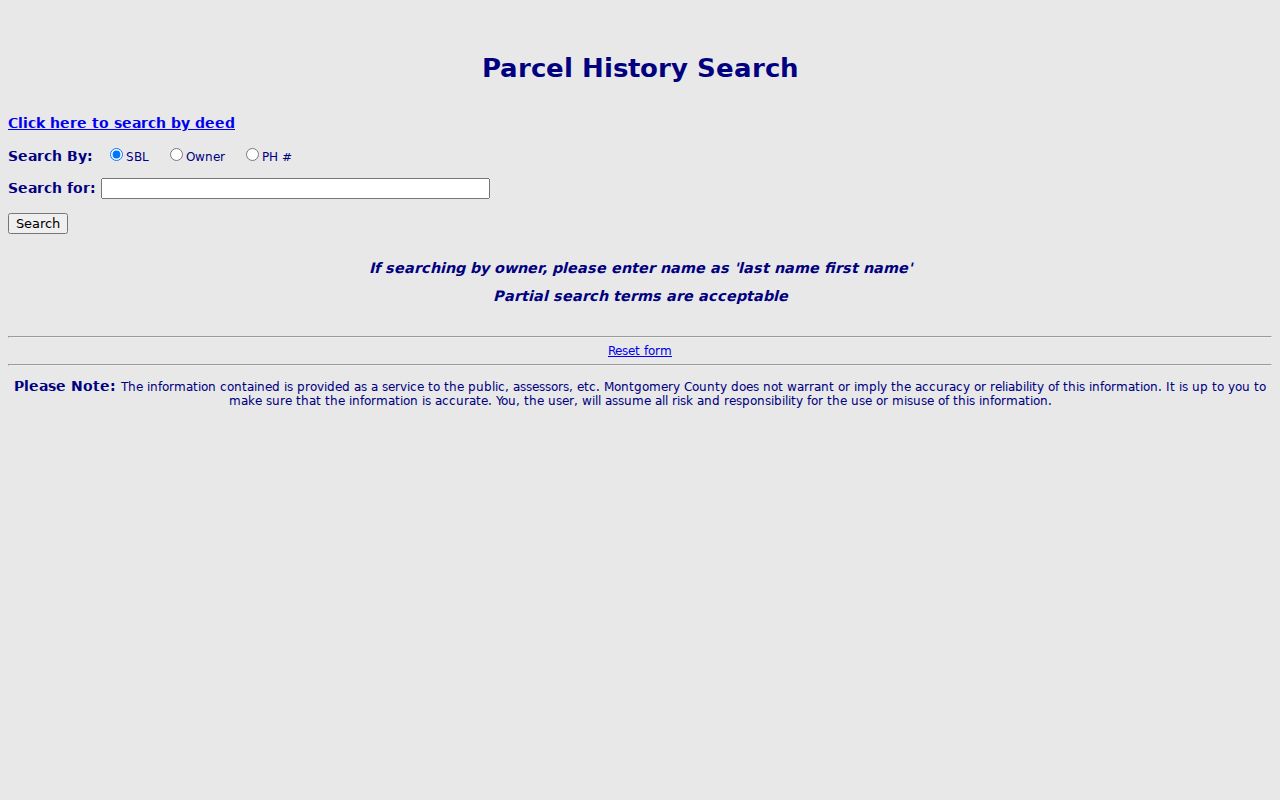
The form's layout shows why owner and SBL searching deserve treatment as related but separate methods. Each mode answers a different question about the same parcel.
| Field | Entry | Best use |
|---|---|---|
| SBL | County parcel identifier | Exact parcel match |
| Owner | Last name first name or partial entity text | Finding possible parcels by party |
| PH number | Parcel History number | Returning to an identified history record |
Montgomery County Sales Filters
The Sales Search answers a different question from the owner roll. It filters by SWIS, property class, and minimum and maximum sale price. Deed-date range, street name, acreage, and SBL elements are options as well. The street instruction asks for the name alone. No house number or suffix is needed. That makes the tool handy for comparing transfers along one road. It is less direct than a full-address search, though. The county Sales Search form documents its actual filters.
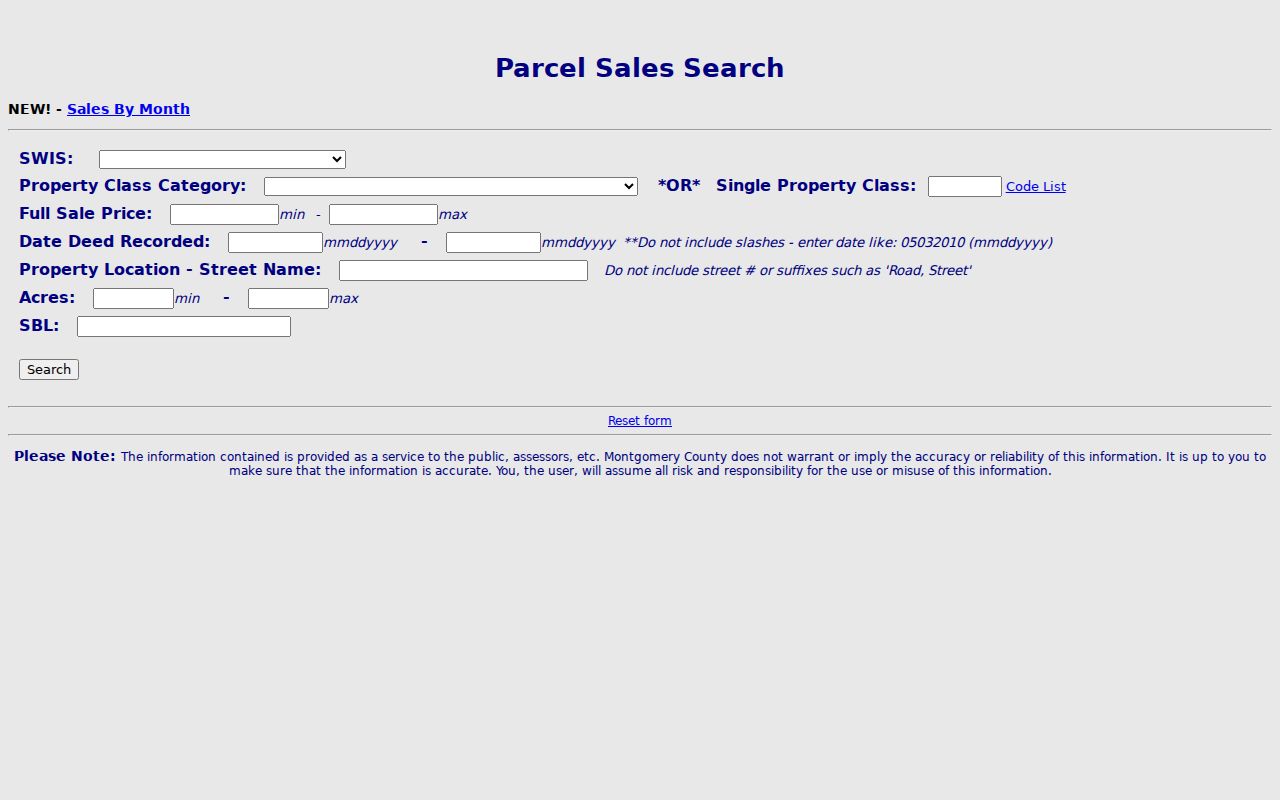
The county form lets you filter sales. Municipal, class, price, date, street, acreage, and parcel criteria each narrow the set of results. Use a sale hit as a prompt to inspect the deed itself. A displayed price can be consideration data rather than a current market estimate. Not every recorded deed reflects an ordinary arm's-length sale. Family, estate, fiduciary, corrective, and other transfers each need their own context.
PROS Assessment Search Context
Montgomery County links to PROS for property inventory, assessment, and comparable-sale information. The county also publishes final-roll PDFs by municipality and year. When the interactive portal does not reveal a parcel, search the correct municipal roll. You can also contact the local assessor. Large PDFs and municipal divisions can make a missing text match look like a missing parcel. It may only be a format issue. The PROS landing page states the portal's assessment and comparable-sales purpose. It also notes its use limits.
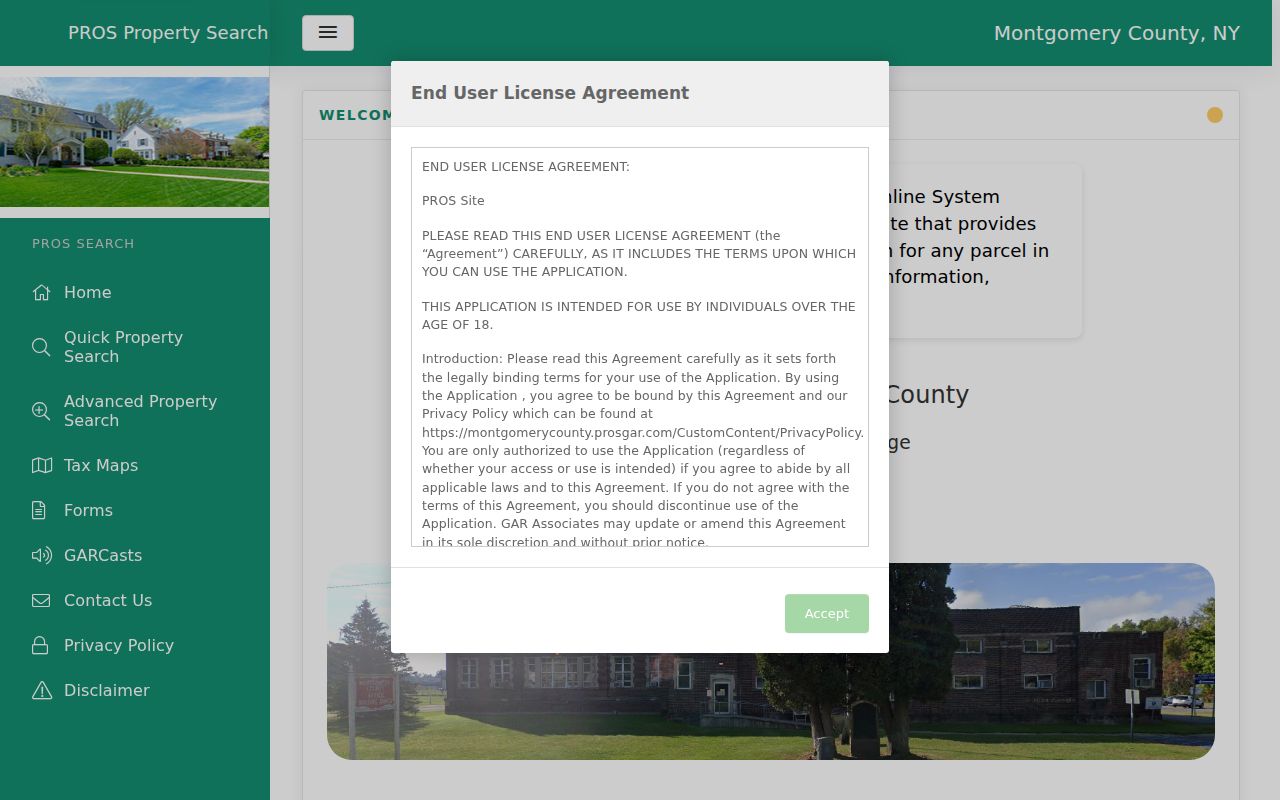
The page identifies the official assessment entry point. The county does not warrant this data as real-time title information, so confirm anything critical against the recorded deed.
- SBL
- Section-block-lot, the county parcel key.
- Situs
- The physical property location rather than the owner's mailing destination.
- Owner of record
- The owner name carried on the selected assessment roll.
- SWIS
- The code distinguishing municipal assessment jurisdictions.
Deed Party Search Handoff
The tax roll hands you an owner and a deed reference. SearchIQS takes it from there. Its controls let you search by Party 1, Party 2, date range, document group, town, book and page, and instrument number. Party roles shift with document type. So open the deed image before deciding that a Party 1 match is really the person you want. Start with an exact spelling. Then broaden the search with initials, prior names, punctuation changes, and business suffixes.
Coverage runs deep but not infinite. Published county coverage lists deeds from December 15, 1971 to the present, with both index and images. Older deeds sit outside that online boundary. When a chain of title crosses the date line, the Clerk's public computers, mail-copy procedure, deed books, and historical sources carry it forward. Online plans and per-page image costs add a wrinkle too: an index hit may be free to see. But the document image requires payment or an office request.
Remember what SearchIQS is. It is a deed-party system, not an address-first assessor. The book and page printed on a roll often make the cleanest bridge between the two. If the roll reference and the newest deed refuse to match, a recent transfer may have arrived after the final roll. So ask Real Property or the Clerk instead of forcing the records to agree.
Tax Bill Search Alternatives
The county tax-bill form asks for a town or school and a year. It then accepts an owner name, bill number, street-name address, or SBL. Pick the right municipality first. A blank result means nothing otherwise. Online availability can lag. The county disclaims both completeness and payment accuracy, so a collector's record or receipt may settle a current payment question.
Timing quirks compound this. A new deed can precede the billing update. County guidance warns that a former owner or escrow service may receive a bill after transfer. No fixed number of lag days is published. Compare the deed date, the final-roll year, and the bill year. Then contact the assessor or collector listed for that municipality. Amsterdam also runs a separate paid city tax-search request. It should not be confused with the free county bill form.
Tax records still earn their place in a property search. They can corroborate the SBL, mailing information, taxing district, and bill status. They cannot prove ownership by themselves. For a recent transfer, the latest recorded deed remains the stronger source.
When Online Search Fails
A failed portal search is a detour, not a dead end. Montgomery County Real Property publishes assessor contacts and final rolls. The office also posts tax rolls, SWIS codes, and parcel-history sources. The County Clerk offers public computers and mail requests. A deed-copy request should include party names, property address, approximate recorded date, and document type. For fast, complex title work, the Clerk recommends a local title company.
Older research continues with the County Historian. The holdings there include early assessments. Tryon and Montgomery land records run from 1772 to 1788. The atlases date to 1853, 1868, and 1905. Sanborn sheets appear only intermittently. Directories, family files, and WPA-copied records fill out the collection. Advance requests should name the property, owners, date span, and desired sources. Remote research runs under posted hourly and time limits.
New York FOIL opens one more route. It covers identifiable agency records that are not already available. A request should describe the record, parcel or address, dates, and preferred format. Court records generally follow Judiciary Law and court procedures instead of FOIL. No access route turns an incomplete description into a guaranteed match. Keep your search notes, and ask the custodian to clarify its indexing system.