
The Values on a Montgomery County Property Record
Several fields work together on a Montgomery County property record. The Amsterdam roll shows how total assessment, taxable value, the uniform percentage, and full-market context relate. It tracks each piece side by side. A Sales Search tool adds a separate trail of transactions. Keep each source distinct when explaining any value you find.
| Value | What It Is | Where |
|---|---|---|
| Land assessment | Assessment allocated to land | Final roll or PROS |
| Total assessment | Roll assessment for the parcel as a whole | Final roll or PROS |
| Taxable value | Amount remaining after the applicable exemption treatment | Roll columns |
| Full-market figure | Roll value related to the displayed uniform percentage | Selected municipal roll |
| Recorded sale price | Price or consideration reported for a transfer | Parcel Sales Search and deed context |
Assessment and sale price are different animals. The roll values a parcel for tax administration, while a deed records one specific transfer. Not every sale is an open-market deal. Some are old, partial, between relatives, fiduciary, or corrective. And the uniform percentage comes from one roll in one year. Never assume it holds across Montgomery County.
Looking Up a Montgomery County Property Value
Begin with the situs address, not the owner's mailing address. Confirm the municipality and SBL. Then read every value from the same roll row or parcel result. Write down the year. Montgomery County property value fields are tied to a specific roll.
- Search the address through Montgomery County PROS or the correct final assessment roll.
- Record land, total assessment, taxable value, exemptions, full-market field, uniform percentage, and year.
- Use Parcel Sales Search for reported transfers and retrieve the deed when transaction context matters.
- Compare genuinely similar parcels and verify inventory, location, and sale conditions before drawing a conclusion.
- Assessed value
- The amount placed on the assessment roll before relevant taxable adjustments.
- Full-market value
- The roll's full-value context under its displayed assessment level.
- Uniform percentage
- The stated relationship used on that roll between assessment and full value.
- Consideration
- The price or value reported with a transfer, which may need deed context.
What a Montgomery County Assessor Value Is Not
An assessment is a fiscal record. It is not a crystal ball. It cannot weigh every condition a buyer or appraiser would notice later. Its effective date and inventory may lag both physical changes and the market. Even the roll's full-market figure stays inside that assessment framework.
Value vs price. A Montgomery County assessed value is not a promise of sale price and is not a property-specific appraisal. Obtain qualified valuation advice when a current market opinion is required.
Read the Montgomery County Roll
The county's final-roll page groups PDF files by municipality and year. The City of Amsterdam roll includes CURRENT OWNERS NAME, mailing address, property location, class, school district, deed book and page, parcel details, assessments, exemption codes, taxable amounts, and special-district fields. Find the exact parcel before reading its value columns. The official final assessment roll page supplies the available municipal files.
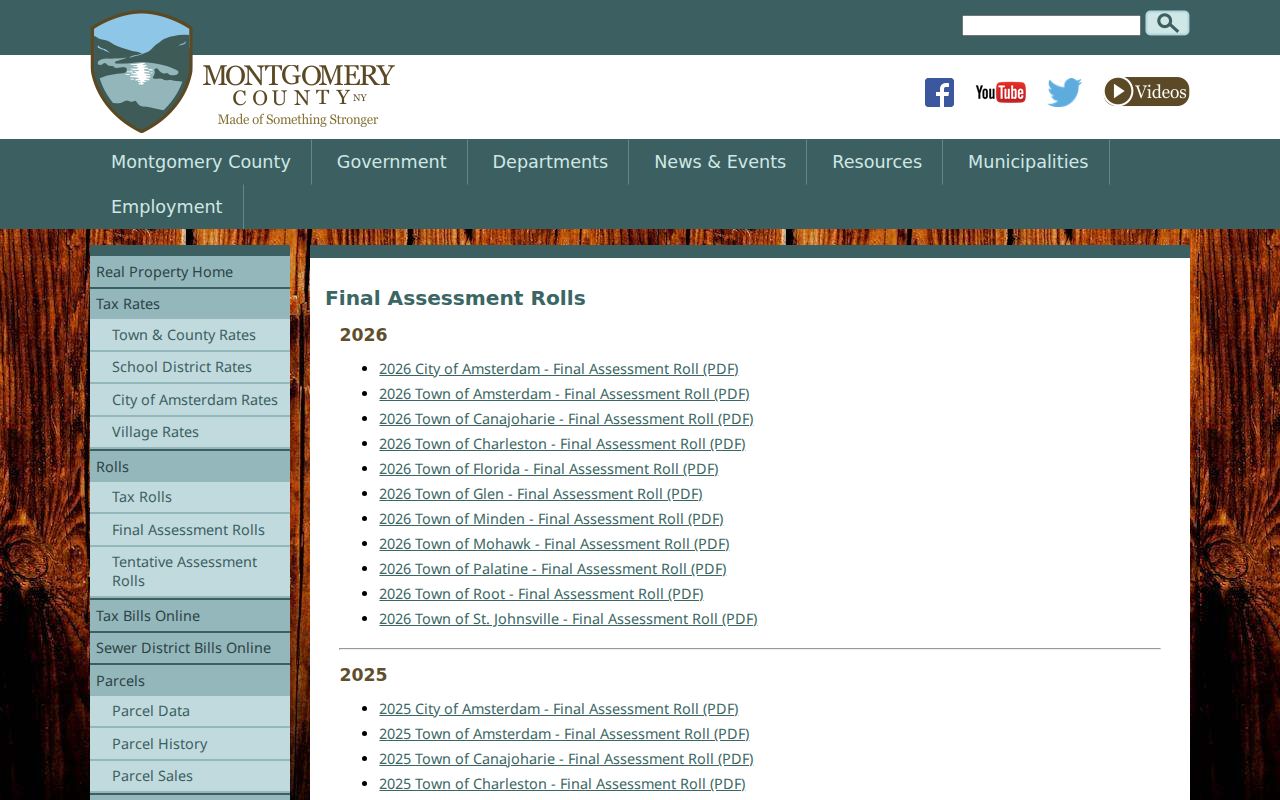
Every value must be tied to the right municipality and roll year. That discipline matters more than any single number. If PDF search fails, locate the SBL through Parcel History or PROS. A large or image-based file can hide its text. That does not mean the parcel lacks an assessment.
Amsterdam's 031.00 Roll Ratio
The 2026 City of Amsterdam roll posts a uniform percentage of value of 031.00. One entry pairs a 38,000 total assessment with a 122,581 full-market figure. That arithmetic belongs to that roll alone. It is not a countywide appraisal rule. Reusing it for another municipality or year, without checking the heading, invites error.
A ratio can make two numbers look connected while leaving the property facts unresolved. Inventory, class, exemptions, and valuation date still matter. Report the posted total assessment and full-market figure rather than quietly converting one into a new estimate.
Special-district amounts for garbage, highway, sewer, or water service are fiscal context only. They are not value components. Do not mistake them for recorded title liens.
Montgomery County Sale Prices
The county Sales Search allows filters for SWIS, property class, price range, deed-date range, street name, acreage, and SBL. Type the street without its number or suffix. Those filters gather potential comparable transfers, though every result still needs verification. The official Parcel Sales Search shows the available criteria.
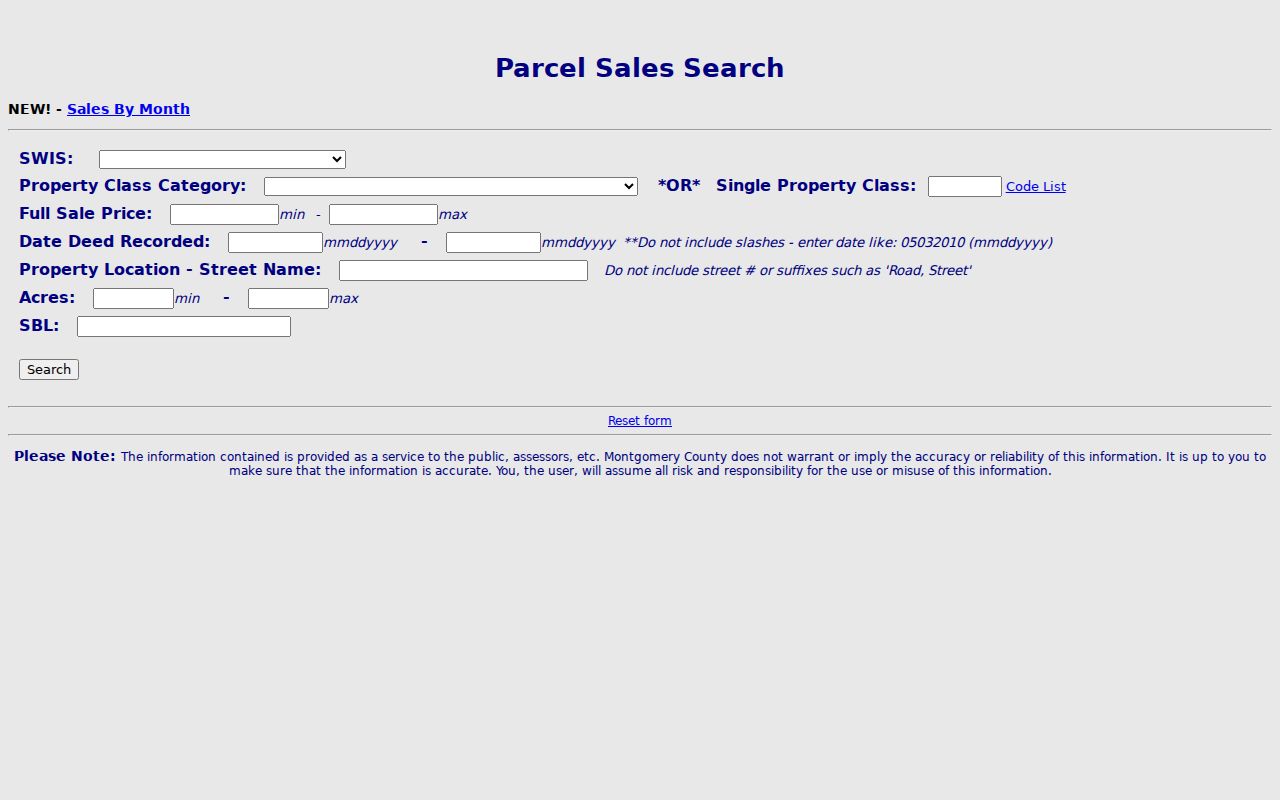
The search page lets municipal, property-class, date, price, street, acreage, and parcel filters narrow the sale set together. Pull the deed before calling a sale comparable. A family transfer, estate deed, partial interest, bundled land, or corrective instrument may not reflect an arm's-length price. Check the property class and improvements too.
Exemptions and Taxable Value
An exemption can shrink taxable value without shrinking total assessment. Senior, agricultural, veteran, STAR, and other programs carry their own eligibility and filing rules. An exemption code reflects the assessor's treatment on that roll. It is not an independent statement of market worth.
When comparing two Montgomery County property value records, keep total assessment apart from taxable columns. A parcel with larger exemption relief can show a lower taxable amount. This can happen even with a similar assessment. The final tax bill also turns on jurisdictions and levies. Those belong on the property-tax page.
A buyer should never assume the seller's exemption transfers. Ask the local assessor which application and taxable-status rules govern the new ownership.
Comparable Sales Need Context
PROS, the state's parcel system, handles the assessment roll and property inventory. It also covers comparable-sale reporting for Montgomery County parcels. A strong comparison controls for several things at once. Match the municipality or market area, the property class, and the site's basic characteristics. Building type, size, condition, and sale period matter too. Amsterdam makes the point well. Its riverfront, former mill districts, downtown core, and outer neighborhoods sit close together on the map. Yet each behaves very differently. A sale next door may prove nothing.
Land-use history shapes the comparison as well. West End BOA and East End planning materials show a clear pattern. A former industrial parcel, a vacant riverfront lot, and a traditional residential property carry different risks and different potential. Planning context alone proves no value. A brownfield study area does not mean every parcel inside it is contaminated. The city's draft 2026 Smart Growth plan adds another layer. It describes outer post-1940 single-family areas alongside traditional two-family neighborhoods. Treat that draft strictly as planning context. It is neither adopted zoning nor a confirmed value trend.
Historic Value Clues
Old records can trace how a property's recorded fiscal value moved across the decades. Permits may explain an improvement. Atlases, directories, and Sanborn maps can reveal buildings or uses that no longer exist. None of these sources converts neatly into today's market value.
The Montgomery County Historian holds early assessments. The office also keeps the 1853, 1868, and 1905 atlases, intermittent Sanborn sheets from 1884 through 1926, and the Amsterdam directories. Pair each source with the deed chain and the current SBL. Street and parcel identifiers may have shifted over the years, so a match takes care. A rising assessment could reflect an improvement, a reassessment, a parcel change, or a policy shift rather than market appreciation alone.
Correcting a Value Record
A wrong property inventory or assessment starts with the local assessor. Compare the roll against accurate parcel facts and bring the discrepancy there. The grievance calendar is set municipality by municipality. Amsterdam posts its date as the third Tuesday in January. Most towns in the county follow one of several May dates instead. Verify the current schedule and forms before filing.
Evidence earns its weight. Photographs, measurements, corrected inventory facts, and relevant arm's-length sales all help. Explain why a proposed comparable differs from the subject. Anchor everything to the valuation date and the exact parcel. A generic online estimate is weaker than property-specific evidence.
Grievance-day mechanics, exemptions, bills, and SCAR fall under the Montgomery County property tax records workflow. The value page stops at understanding and documenting the numbers.