
What the Montgomery County Current Owner Record Shows
The Amsterdam final roll places the name under a heading marked CURRENT OWNERS NAME. Mailing and property addresses sit apart. Check the heading, the municipality, and the roll year before treating any owner name as current.
| Current owners name | The party carried on that municipal final roll |
|---|---|
| Owner mailing address | Where assessment or tax correspondence is directed |
| Property location | The parcel situs, which may differ from mailing address |
| SBL | The section-block-lot key identifying the assessed parcel |
| Deed book and page | A lead to the Clerk instrument supporting the roll entry |
| Roll year | The time context for every reported owner and value field |
Ownership and occupancy are different things in Montgomery County. A business or trust can hold the parcel. A tenant, a property manager, a relative, or a contractor may appear in another file without holding any title. Treat the roll's mailing address as a lawful contact clue only, never proof of where the owner lives.
Confirming the Current Owner in Montgomery County
Confirming ownership in Montgomery County is a present-tense job. Start with the roll name and its parcel number. Then pull the newest deed touching that land, and compare the grantee, the legal description, and the recording date; a fresher deed controls whenever the roll lags behind.
- Read the owner field on Montgomery County PROS or the correct final assessment roll.
- Use its SBL and deed reference to pull the newest deed from SearchIQS or the County Clerk.
- For an entity owner, check the exact legal name in the New York business entity database.
- Record the roll date, deed recording date, and mailing address without treating the latter as occupancy.
- Owner of record
- The party named as owner by the official source at its stated date.
- Vesting
- The deed language stating how the grantee or grantees hold title.
- Registered agent
- An entity's service contact, not automatically the owner of its real estate.
Reaching a Montgomery County Property Owner
The assessment roll's mailing address is the official contact clue supplied for the parcel. Use it for a focused matter. A boundary question, purchase inquiry, or easement issue qualifies. Never republish the address. And don't assume the owner lives there, since some New York programs shield a real address behind a substitute one.
Lawful use. A public mailing address may support respectful property contact. Never use current-owner information to stalk, intimidate, threaten, or harass a person.
Montgomery County Roll Evidence
The final-roll index is arranged by municipality and year. Pick the right file first. Each Montgomery County roll can report the owner, mailing address, situs, class, land and total assessment, exemptions, taxable value, school district, deed reference, and account or grid details. Every field belongs to that roll. So quote it as what the posted roll shows, never as a guarantee of present title. The official final assessment roll index opens the municipal files.
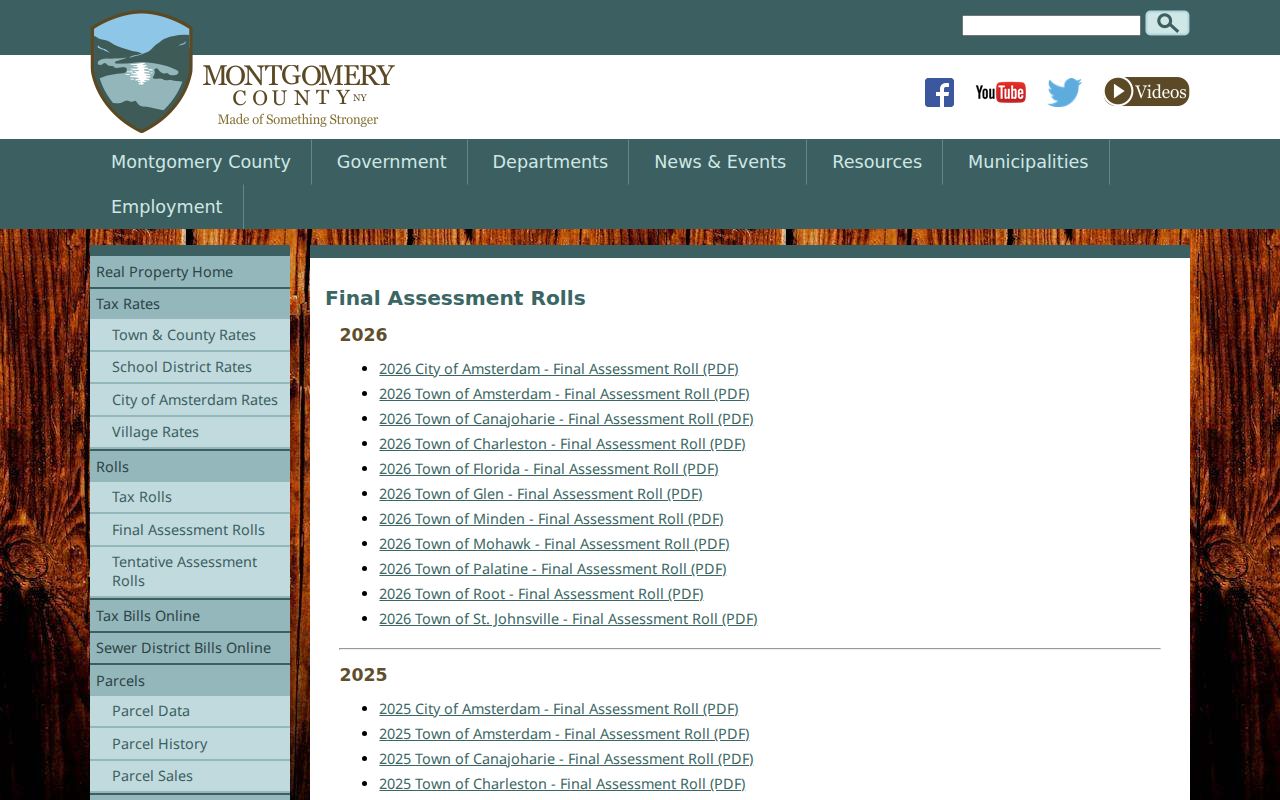
The index layout forces a choice of municipality and roll year. Only after that does the owner field mean anything. Roll PDFs can be huge. OCR limits can also hide a valid entry inside them. If a PDF search comes up empty, run the SBL or owner name through Parcel History. Then try alternate name formatting, or contact the assessor.
Current Owner Transfer Lag
Montgomery County itself warns about a possible mailing lag. A bill may still reach a former owner or escrow company after a transfer. The county promises no fixed update interval. So the deed can be newer than the owner field on a final roll or tax bill. The deed can also outrun the owner field carried on a tax bill. Compare dates instead of labeling one record wrong. A name on a tax bill never overrides the newest valid deed.
For a sale just recorded, pull the deed image first. Check the grantee and the land it covers. Then ask Real Property how the change will appear on the next assessment cycle. If the parcel split, find out whether a parent or child SBL is involved.
This lag has one more consequence. Any claim of ownership since must rest on the deed date. It could also rest on the recording evidence. It cannot rest on when a portal first displayed a name.
Current Owner Deed Check
SearchIQS carries Montgomery County deeds from December 15, 1971 forward, with index entries and images. Search the roll owner as a grantee and restrict the document group to deeds. Then match book and page or instrument references. When multiple parcels or same-name parties appear, the legal description becomes essential.
Read the deed's wording. It may name joint grantees, an LLC, a trust-related party, an executor, or another fiduciary. Don't flatten it into a simpler owner label. A mortgage recorded the same day transfers nothing, and a later discharge conveys no parcel either.
Older chains fall back on the Clerk's in-office computers, the mail-copy procedure, the deed books, and Historian resources. The current-owner task needs only the latest supported vesting. But its source must still be retrievable.
Entity Owner Verification
An owner string like an LLC or corporation can be clarified through the New York Department of State database. It returns the official entity name, organization date, jurisdiction, county, service-of-process address, registered agent when listed, and status. Match the deed's exact grantee text first. Only then pick an entity result.
Entity data never expose everyone with an economic interest. A registered agent is not the parcel's owner. The deed itself names the entity holding the stated interest in the Montgomery County parcel. A County Clerk DBA filing can explain an assumed business name, but it does not replace that deed.
Trusts limit public visibility. Sources may show only the trustee or the trust name used in the instrument, so never infer private beneficiaries. For an estate, check the deed and relevant public probate material for authority. A docket entry alone does not convey title.
Protected Owner Addresses
New York runs an Address Confidentiality Program under Executive Law section 108. It gives eligible participants a substitute address. Election Law section 5-508 allows confidential voter registration in certain circumstances too. That is why an official property records source may withhold a real residence.
A substitute mailing address does not weaken the deed evidence for a parcel. It simply changes where contact gets directed. Respect the published route rather than trying to work around a protection. Most property questions can go through the owner of record, a registered agent, an attorney, or the right county office. Nobody needs a private home location to resolve them.
Keep the current owner inquiry narrow. Ask who the official property records name. Ask which record supports that name, and how current the source is. The search should never turn into finding out who sleeps at the property.
Current Owner Fraud Monitoring
The County Clerk links to SearchIQS Fraud Alert, a free monitoring service. Enter a person or company name. It emails a notice whenever a matching document gets recorded. Enrollment covers up to ten names and needs email activation. For a current owner, it offers a way to watch for unexpected filings. The watch covers filings against the name on the deed.
The alert has limits. It is not real time. It can flag same-name matches, and it will not block a document from being recorded. It is also not title insurance. When a filing looks unauthorized, open the official record. Verify the parcel and the parties. Then respond through the Clerk, an attorney, or the authorities.
Monitoring rounds out a present-owner property search. It does not correct the tax roll or fix a deed. It does not settle a dispute by itself.